

By John Spencer
The inversion keeps happening in plain sight. Hezbollah attacks Israel. Israel responds. Much of the Western press then presents the Israeli response as the escalation while Hezbollah’s attacks are compressed into a passing line or removed altogether. After months of repetition, the public absorbs a version of events detached from the actual sequence.
Two days after the United States and Israel launch Operation Epic Fury and Operation Roaring Lion against Iran on February 28, Hezbollah fires rockets into northern Israel. The March 2 attacks break the fragile ceasefire that has existed along the northern border since late 2024. Hezbollah makes the choice deliberately. It aligns itself with Tehran’s war effort instead of preserving stability inside Lebanon.
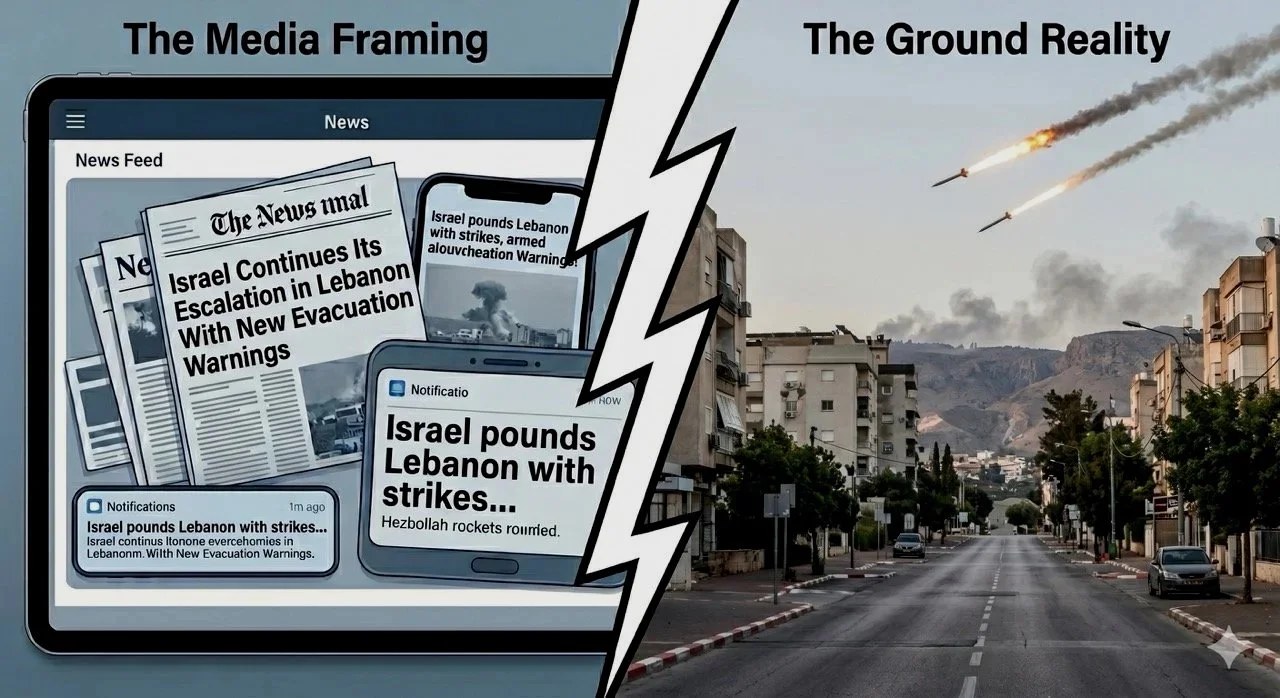
The headlines posted and amplified by major media outlets tell readers something very different. Titles such as “Israel Continues Its Escalation in Lebanon With New Evacuation Warnings” and “Israel pounds Lebanon with strikes, expands ground operations past security zone” dominate much of the coverage. Day after day, the emphasis falls overwhelmingly on Israeli operations, Israeli warnings, Israeli escalation, and Israeli airstrikes. Hezbollah’s attacks often appeared deep in the article, stripped of scale and frequency, if they appeared at all. Across much of the Western media landscape, the impression left for readers is that Israel drives the violence while Hezbollah simply exists somewhere in the background of the story that it actually starts.
The reality in northern Israel bears no resemblance to that framing. Communities such as Kiryat Shmona and Metula remain emptied for long stretches because Hezbollah continues firing rockets, drones, mortars, and anti-tank missiles across the border. Families cannot safely return to their homes while attack sirens continue sounding daily. Even during periods internationally described as ceasefires or de-escalation phases tied to the U.S.-Iran conflict, Hezbollah keeps launching drones and rockets toward Israeli territory.
The scale and persistence of the attacks rarely appear honestly in international coverage. By late March, Israeli officials report that more than 3,500 rockets, missiles, and drones had already been launched toward Israeli communities from Lebanon since March 2. Alma Research and Education Center separately documented roughly 779 Hezbollah attack waves between March 2 and March 21 alone, averaging nearly forty attacks per day. Even after the April 17 “ceasefire,” Hezbollah continues attacking Israel. Alma reports that from April 17 through May 24, Hezbollah carries out another 545 attack waves involving rockets, drones, FPV systems, and attacks against Israeli forces and northern communities. Hezbollah’s operational purpose remains unchanged. The terror organization seeks to keep northern Israel under constant pressure while much of the international conversation continues treating Israel as the initiator.
That distortion now shapes public understanding far beyond the battlefield itself. Israel is often discussed as though it exists outside the standards applied to every other sovereign nation. For months, rockets strike civilian communities while armed drones target patrols, border positions, and towns across northern Israel. Tens of thousands of Israelis remain displaced from their homes. Yet once Israel responds militarily, much of the international focus shifts almost immediately away from the side initiating the attacks and toward the country attempting to stop them.
There is another reality that receives remarkably little attention outside the region itself. Hezbollah’s leadership openly calls for the overthrow of Lebanon’s government while continuing to portray itself internationally as a resistance movement. Hezbollah’s newly appointed leader, Naim Qassem, urges supporters into the streets against Lebanon’s elected authorities while Hezbollah continues dragging Lebanon toward instability, economic collapse, and perpetual war. This is not a movement defending Lebanese sovereignty. Hezbollah functions as an armed state within a state, preserving its independent military power at the expense of Lebanon’s future while subordinating the country to Iran’s regional agenda.
The deeper issue is Hezbollah’s position inside Lebanon itself. It possesses military capabilities stronger than many national armies. It maintains rocket stockpiles, extensive tunnel infrastructure, command facilities embedded throughout civilian areas, and an independent chain of command tied directly to Tehran. Hezbollah never accepts meaningful disarmament after previous wars and never places itself under full Lebanese state authority. The ceasefire arrangements reached in late 2024 collapse because Hezbollah continues functioning as Iran’s forward military proxy on Israel’s border.
Peace requires honesty about what continues preventing it. Hezbollah embeds military infrastructure throughout civilian areas across southern Lebanon, placing Lebanese civilians at constant risk whenever fighting erupts. The organization refuses meaningful disarmament because permanent confrontation with Israel preserves both its domestic influence and its strategic value to Iran. As long as Hezbollah operates as an armed force outside Lebanese state authority, the conditions for recurring war remain firmly in place.
No Western government would tolerate sustained rocket and drone attacks against its civilian population for long without military action. The United States would never accept armed groups firing missiles across the Mexican border for months while Washington is told restraint alone is the appropriate response. France would not tolerate daily rocket attacks against Metz. Britain would not allow armed organizations to launch drones into northern England while demanding London avoid escalation.
Israel possesses the same right as every other sovereign state. It has the responsibility to protect its citizens and restore security to communities driven from their homes by Hezbollah’s attacks. That responsibility includes dismantling military infrastructure, weapons stockpiles, launch positions prepared for attacks, and the fighters actively carrying out operations against Israeli civilians.
The inversion surrounding Hezbollah’s war against Israel does more than distort headlines. It shapes diplomacy, public pressure, and international perceptions of legitimacy. When Hezbollah’s attacks disappear from coverage while Israeli responses dominate international reporting, audiences lose any clear understanding of how the fighting is actually unfolding. No ceasefire can survive if one side continues launching rockets, drones, and missiles while the responding state is portrayed as the primary aggressor. Peace becomes far harder to achieve when the basic sequence of events is repeatedly inverted to obscure who continues reigniting the conflict.
Photo Credit: Photo Credit: The MirYam Institute-AI Generated-® All Rights Reserved
John Spencer, The MirYam Institute Senior Analyst On Urban & Asymmetrical Warfare. He is considered one of the world’s leading urban warfare experts and has conducted extensive on the ground research in Israel and Gaza since October 7th. Read full bio here.