

By John Spencer
The war against Iran that began on February 28 was never designed as a regime-change campaign. Had the United States intended to overthrow the Islamic Republic, it would have applied vastly different forces and pursued Tehran’s political collapse from the opening hours. Operation Epic Fury, a regime-behavior change campaign, began with limited objectives:
Eliminate Iran’s nuclear weapons threat
Destroy its offensive missile capability
Destroy its navy
Sever its support for terrorist proxy organizations.
Those objectives were publicly stated at the beginning of the campaign and have remained consistent. Iran must abandon its nuclear weapons program, surrender or remove its enriched uranium, and accept a robust and intrusive inspection regime. It must end its coercion of commercial shipping in the Strait of Hormuz, accept full freedom of navigation, limit the missile and drone programs that protect its aggression, and pay continuing costs for supporting terrorist armies across the region.
The endgame remains regime behavior change. Iran’s remaining leaders must decide that preserving the Islamic Republic requires abandoning the programs and actions that brought the country into war. They do not have to become friends of the United States, embrace Western democracy, or surrender control of the Iranian state. They must accept that continuing their current behavior will place their military power, governing institutions, personal security, and ultimately the survival of the regime in greater danger.
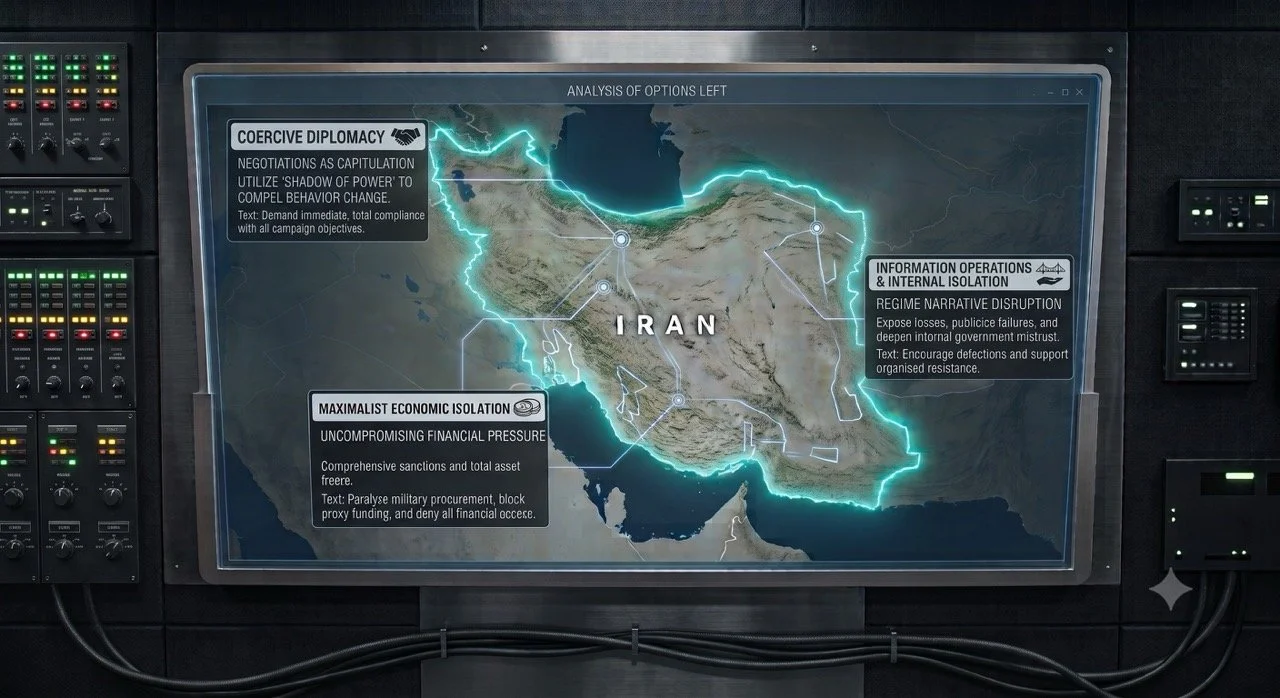
Yes, capitulation is the goal. That word may make some people uncomfortable, but it accurately describes the desired outcome. The United States wants Iran to accept conditions it has resisted for decades because American military power has made further resistance unbearable. George Shultz captured that relationship between diplomacy and force when he said, “Negotiations are a euphemism for capitulation if the shadow of power is not cast across the bargaining table.” His point was not that negotiations are meaningless. His point was that negotiations produce little when one side believes time, delay, and continued resistance will improve its position.
Operation Epic Fury destroyed much of Iran's military capability. American forces flew more than 10,200 sorties and struck more than 13,000 targets, while Israel conducted thousands of additional sorties, including more than 2,100 over Tehran. Together, the two campaigns targeted senior leadership, command-and-control systems, military industrial facilities, missile infrastructure, air defenses, naval forces, and key elements of Iran's nuclear enterprise. They demonstrated the ability to penetrate Iranian airspace at will, locate protected military assets, eliminate senior commanders, and dismantle capabilities the regime had spent decades developing.
The campaign imposed enormous costs, although those costs have not yet compelled the regime to accept American terms. Iran has continued to resist demands concerning its nuclear program and freedom of navigation. Iran’s conventional means have been badly damaged. Its will has survived. That is the problem the next phase must solve.
The next phase should place the regime under simultaneous military, economic, diplomatic, informational, and psychological isolation. Compellence is cumulative. Military action, economic pressure, diplomacy, intelligence, cyber operations, information operations, and support to internal resistance should reinforce one another until the regime concludes that continued resistance threatens what it values most: its power and survival. Iranian leaders should lose the ability to communicate securely, gather safely, move military forces freely, protect the coastline, observe the strait, generate military revenue, or assume that they can outlast American attention. Every day of resistance should leave the regime weaker, more divided, and less confident about its own survival.
There is no single operation that guarantees this result. The United States could select any of the following measures, combine several of them, employ nearly all of them over time, or reject those that do not fit the political and military circumstances. Their value lies in giving the president options and forcing Iran to defend against possibilities it cannot confidently exclude.
Possible actions against the regime’s wartime leadership include:
Continue targeting senior regime and IRGC leaders. Military, intelligence, missile, naval, drone, nuclear, and command officials who direct or enable ongoing hostilities.
Strike command posts, emergency headquarters, communications centers, and protected meeting locations used to direct the war.
Force commanders to disperse, relocate constantly, restrict their communications, and abandon established headquarters.
Use cyber, intelligence, information, and covert action to make senior leaders feel exposed wherever they operate.
Publicize defections, internal disputes, corruption, failed operations, and leadership losses to deepen mistrust within the government.
Make continued participation in the war personally costly for those directing attacks against American forces, regional partners, and international shipping.
The senior political and military leadership should not enjoy sanctuary while Iranian forces attack American personnel and attempt to control the Strait of Hormuz. Those directing the war should be hunted, isolated, and prevented from exercising effective command. Their military headquarters, communications systems, protective organizations, and operational networks should remain under constant pressure.
Possible actions against Iran’s communications and transportation systems include:
Sever military communications linking Tehran with regional headquarters, missile forces, naval commands, air defenses, and proxy organizations.
Disable government television and radio systems used for military mobilization, operational messaging, and regime command.
Disrupt military internet networks, secure communications, satellite links, and emergency command channels.
Preserve or expand outside communications that allow ordinary Iranians to receive information beyond regime control.
Destroy transportation nodes used to move missiles, drones, weapons, commanders, and military reinforcements.
Interdict military rail lines, bridges, tunnels, highway junctions, and logistics corridors connecting production sites with operating forces.
Isolate major military installations from reinforcement and resupply.
Prevent military units outside Tehran from moving quickly to defend the capital or suppress organized resistance.
Expand efforts to disrupt/halt military resupply into Iran by air, land, and sea.
Interdict the movement of weapons, missile components, drone parts, dual-use technology, industrial equipment, and other military materiel supplied by foreign partners.
Increase diplomatic and economic pressure on neighboring states, airlines, shipping companies, and commercial networks that facilitate military resupply.
Information operations should accompany the physical isolation of the regime. Tehran relies on television, radio, internet restrictions, censorship, and official messaging to preserve the appearance of control and convince the population that continued resistance is both necessary and sustainable. The United States could challenge that monopoly by speaking directly to the Iranian people, the armed forces, government officials, and regime supporters.
Possible informational actions include:
Disrupt regime television and radio broadcasts used for military mobilization, propaganda, and internal control.
Broadcast directly to the Iranian people through radio, satellite television, digital platforms, and any communications channels that bypass regime censorship.
Publicize regime losses, leadership failures, corruption, internal disputes, and the destruction of military capabilities Tehran attempts to conceal.
Provide instructions for accessing uncensored information and bypassing internet restrictions.
Encourage defections and refusal of orders by offering clear assurances to personnel who abandon the regime’s military campaign.
Reassure the Iranian population that the campaign’s objectives remain limited to ending the nuclear threat, restoring freedom of navigation, reducing Iran’s offensive military capabilities, and terminating support for terrorist proxy organizations.
Make clear that continued destruction is the result of the regime’s refusal to accept terms that would end the conflict.
The information campaign should isolate Iran’s leaders from the population they claim to represent. It should undermine the regime’s narrative, widen divisions within the government and security services, and convince ordinary Iranians that the regime’s decisions are placing the country in growing danger.
The purpose would be to fragment Iran's wartime and regime-control system while denying it the ability to rebuild from abroad. Military formations should have difficulty receiving instructions, moving supplies, coordinating attacks, replacing combat losses, obtaining critical components, or restoring damaged capabilities. Leaders in Tehran should feel increasingly isolated from the organizations that protect them and from the foreign networks supplying the money, technology, equipment, and materiel needed to sustain the war.
Possible actions against electrical power and military infrastructure include:
Cut external power transmission serving military headquarters, nuclear sites, missile facilities, naval bases, air defenses, and intelligence compounds.
Destroy or damage substations and transmission links dedicated to military operations.
Attack emergency power systems supporting command centers and weapons facilities.
Use cyber operations to create recurring failures across military power networks.
Black out military districts and government command facilities in Tehran.
Preserve power serving hospitals, water systems, food distribution, and other essential civilian functions wherever operationally possible.
Turning Tehran’s centers of military and government command dark would have military and psychological effects. It would show that the regime cannot protect the capital, suppress the population, maintain its wartime systems, or guarantee the security of its own leaders. The Gulf Wars demonstrated how attacks on power distribution and command connectivity can paralyze a military system without requiring the destruction of every generator or power source.
Possible actions against Iran’s military industry and sources of wartime revenue include:
Finish the destruction of metallurgical plants supporting missiles, drones, armored systems, naval weapons, and military construction.
Strike specialized steel, aluminum, composite, chemical, electronics, propulsion, and machine-tool facilities tied to weapons production.
Destroy surviving missile and drone assembly lines.
Eliminate centrifuge-production facilities, uranium-conversion infrastructure, weaponization sites, and specialized nuclear support facilities.
Interdict imports of machine tools, microelectronics, guidance components, chemicals, and solid-fuel ingredients.
Conduct cyberattacks against financial networks used by the IRGC, the defense industry, and terrorist proxy organizations.
Freeze, seize, or disrupt regime-controlled accounts and overseas assets.
Block payments to military suppliers, proxy forces, smugglers, and procurement agents.
Strike additional oil facilities when they directly support military operations, wartime exports, or regime-controlled financing.
Economic pressure should continue alongside military operations. Long before Operation Epic Fury, the United States had imposed one of the most comprehensive sanctions regimes in the world against Iran. Since February 28, Treasury has expanded that campaign by targeting the regime's remaining sources of revenue, procurement networks, shipping industry, financial facilitators, and overseas commercial infrastructure. The United States still possesses significant untapped economic leverage that can further constrain Iran's ability to finance, rebuild, and sustain its military capabilities.
Possible economic measures include:
Expand secondary sanctions against foreign banks conducting transactions with sanctioned Iranian entities.
Expand sanctions against Iran's petrochemical, steel, aluminum, mining, and metallurgical sectors that support military production or generate regime revenue.
Target additional front companies, procurement agents, and overseas commercial networks acquiring components for Iran's missile, drone, naval, and nuclear programs.
Expand export controls on semiconductors, precision machine tools, advanced electronics, propulsion components, specialty chemicals, and other dual-use technologies.
Increase sanctions on cryptocurrency exchanges, exchange houses, and financial intermediaries helping the regime move or conceal funds.
Increase multinational enforcement with European, Gulf, and Asian partners to close remaining sanctions loopholes and deny Iran access to international financial and commercial markets.
Increase pressure on international financial institutions to further isolate Iran from the global banking system.
Economic pressure is another line of effort. It denies the regime the money, technology, industrial capacity, and international access needed to rebuild the military capabilities destroyed during Operation Epic Fury. Every month Iran cannot replace missiles, centrifuges, drones, air defenses, naval systems, or military production capacity magnifies the strategic effects of the military campaign.
Iran cannot be permitted to rebuild while negotiations continue. Every delay should cost Tehran additional production capacity, trained personnel, stored weapons, and access to foreign components. The regime must understand that time now favors the United States.
The Strait of Hormuz requires its own military campaign. Iran has declared the waterway closed, attacked shipping, and attempted to impose its own rules over international passage. Allowing Tehran to retain that authority would hand it a strategic victory despite the destruction inflicted during Epic Fury.
Possible actions to restore freedom of navigation include:
Maintain a full naval blockade on Iran.
Isolate Iran’s coastline from military resupply and reinforcement.
Destroy military radars, surveillance systems, command posts, drone facilities, and communications nodes supporting attacks at sea.
Destroy coastal missile batteries threatening commercial and coalition vessels.
Eliminate IRGC Navy speedboats, minelayers, unmanned vessels, missile craft, and concealed coastal positions.
Clear naval mines and destroy the facilities used to manufacture, store, and deploy them.
Establish and enforce exclusion zones around Iranian coastal military positions.
Provide protected transit corridors and coalition escorts for commercial vessels.
Attack military facilities at Bandar Abbas that support operations in the strait.
Isolate Qeshm, Larak, and other militarized islands from reinforcement.
Destroy the military infrastructure on Qeshm, Larak, Lesser Tunb, Greater Tunb, Abu Musa, Hormuz, Hengam, and other militarized islands that remains after the evacuation deadline.
Temporarily seize limited terrain when air and naval power cannot remove a continuing threat.
Hold selected coastal or island positions until freedom of navigation has been restored.
The United States has already struck Iranian missile systems, air defenses, and IRGC boats operating around the strait. A larger campaign could expand those actions until Iran loses the practical ability to threaten international shipping from its coast and islands.
The maritime campaign should also expand beyond restoring freedom of navigation. It should directly threaten the regime's economic lifeline.
Possible actions include:
Seize Kharg Island, Iran's principal oil export terminal, and suspend exports under regime control until Iran accepts negotiated terms.
Destroy remaining military facilities supporting regime operations on Kharg and other strategic islands.
Maintain coalition control of the surrounding waters until Iran permanently ends its threats to international shipping.
American ground forces should remain part of the range of options. The aversion to another occupation has understandable roots in Iraq and Afghanistan. It has hardened, however, into a self-imposed declaration that American troops cannot enter Iran for any purpose or remain there for any length of time.
The worst approach in war is repeatedly telling the enemy what the United States refuses to do. Iran should have to fear and defend against raids, airborne operations, amphibious seizures, temporary lodgments, and special operations. The mere possibility creates additional problems for Iranian commanders and forces them to protect terrain that would otherwise remain safe.
Possible ground-force missions include:
Seize Kharg Island.
Seize Larak Island or another limited position controlling approaches to the Strait of Hormuz.
Conduct raids against coastal missile, mine, radar, drone, and naval facilities.
Insert airborne forces into a remote and defensible area for a limited military purpose.
Raid hardened sites that cannot be reliably destroyed from the air.
Capture or destroy mobile missile systems and underground support sites.
A limited ground mission would not automatically produce an occupation or national building project. American forces have conducted raids, seizures, rescues, and temporary deployments throughout modern military history without assuming responsibility for governing entire countries. Ground forces should remain available wherever their presence can achieve something air, naval, cyber, and space power cannot accomplish alone.
The regime’s control over the Iranian population offers another source of leverage. The Basij, intelligence services, police units, detention networks, and IRGC formations protect the government from internal opposition. As external defenses weaken, those organizations become even more important to regime survival.
Possible actions against the regime’s internal control include:
Attack Basij and IRGC units that participate in the war or provide armed protection for military command facilities.
Disrupt intelligence and security communications used to coordinate armed repression.
Expose the names, finances, and activities of officials responsible for violent suppression.
Disable surveillance systems used to track opposition leaders and organized resistance.
Support secure communications among credible opposition networks.
Provide intelligence, funding, communications equipment, medical support, and other assistance to organized groups capable of sustained resistance.
Encourage defections from the armed forces, police, Basij, and intelligence services.
Consider controlled support to disciplined opposition organizations with established leadership and political objectives.
Use covert action to increase the pressure surrounding Tehran and other critical centers of regime power.
Support to opposition forces would carry serious risks and would require reliable partners. It still belongs among the available options. The United States should not dismiss a source of pressure merely because it is politically difficult or because the regime would condemn it.
Another option would be increasing pressure on the regime from Iran's geographic periphery. Whether through Kurdish organizations, Baluchi groups, Arab communities in Khuzestan, or other organized opposition movements, any effort to support armed groups would involve significant political, military, and humanitarian risks. Introducing or expanding armed minority movements could create dynamics that outlast the war itself.
That does not mean peripheral pressure lacks strategic value. Organized resistance operating far from Tehran could force the regime to divert military and internal-security forces away from protecting the capital, missile infrastructure, and other strategic objectives. It could complicate military logistics, threaten lines of communication, and require the regime to devote additional attention and resources to internal security at a time when it is already under sustained external military pressure.
Meanwhile, attacks on Iran’s remaining military means should continue without interruption:
Missile launchers and storage facilities.
Drone launch sites and production lines.
Air defenses and associated radars.
Naval bases and coastal weapons.
Nuclear facilities and supporting infrastructure.
Command-and-control nodes.
Weapons laboratories and testing sites.
Military logistics and fuel reserves.
Proxy training, financing, and weapons-transfer networks.
Foreign procurement organizations.
Underground military facilities.
One obvious question is why the United States has not pursued many of the additional options available to it. The answer is that every option carries costs. Some increase the risk to American forces. Others raise the danger of regional escalation, threaten partners and allies, affect global energy markets, or increase risks to the Iranian population. Those second- and third-order effects are precisely why military campaigns are matters of political judgment as much as military capability. The existence of an option does not mean it should be exercised. It does mean policymakers must weigh whether the risks of additional pressure are greater than the risks of leaving the campaign's stated objectives only partially achieved.
The range of available options matters because Iran must understand that Operation Epic Fury did not come close to exhausting American power. Tehran cannot assume that surviving the first campaign guarantees the survival of its remaining military capabilities, sources of revenue, command structure, or governing institutions. The United States does not need to employ every measure. It needs Iran to believe that Washington retains the ability and the will to increase pressure across multiple domains if the regime continues to resist.
Washington should continue to state the terms for ending the campaign. Iran must surrender its nuclear weapons program and enriched uranium, accept intrusive inspections, end its coercion in the Strait of Hormuz, permit unrestricted freedom of navigation, accept meaningful limits on its missile and drone programs, and terminate military support for terrorist proxy organizations.
Operation Epic Fury proved that destroying Iran's ability to project military power beyond its borders is necessary. It also demonstrated that military destruction alone is insufficient to compel the regime to change its behavior. The next phase should therefore place increasing pressure on the regime's ability to govern by confronting it with several reinforcing dilemmas at once. Iran should have to protect its leaders, defend Tehran, maintain internal control, restore military communications, prevent opposition activity, secure its borders and coastline, protect its oil revenue, rebuild damaged forces, and preserve access to foreign resupply simultaneously. Pressure across multiple fronts would force the regime to divide its attention, personnel, financial resources, and remaining military capabilities while leaving its leaders uncertain where the next blow will fall.
Tehran cannot remain a sanctuary. It is the center of the regime's political authority, military command, economic power, internal security apparatus, and information control. As long as Iran's leaders believe they can govern securely from the capital, direct the war, suppress the population, and simply wait for American resolve to weaken, compellence will fail. Continued resistance must increasingly threaten their ability to govern from Tehran and ultimately the survival of the regime itself.
That pressure would still serve the limited objectives established at the beginning of Operation Epic Fury. The objective would remain a negotiated change in Iranian behavior, not the conquest or permanent occupation of Iran. The United States should bring overwhelming military, economic, diplomatic, intelligence, cyber, and informational power to bear in an integrated campaign that leaves the regime with a single conclusion: accepting American terms offers the only realistic path to preserving the regime and their own survival.
The campaign should continue until Iran accepts those terms. Diplomacy may record the final agreement, but compellence will create the conditions that make agreement possible. The United States still has many options left in Iran. The question is no longer whether additional instruments of American power exist. It is whether Washington is willing to employ them in sufficient combination to convince Tehran that continued resistance is more dangerous than accepting American terms.
Photo Credit: Photo Credit: The MirYam Institute-AI Generated ® All Rights Reserved
John Spencer, The MirYam Institute Senior Analyst On Urban & Asymmetrical Warfare. He is considered one of the world’s leading urban warfare experts and has conducted extensive on-the-ground research in Israel and Gaza since October 7th. Read full bio here.