

By Yaakov Lappin
For the past eleven nights, U.S. Central Command (CENTCOM) has carried out a series of highly precise airstrikes against Iranian military targets, primarily though not exclusively along the southern coastline. These strikes target radar stations, cruise missile launch positions, drone bases, control towers, and other capabilities utilized by the Islamic Revolutionary Guard Corps (IRGC) to disrupt civilian shipping in the Strait of Hormuz.
Tehran’s goal is strategic messaging. Having suffered catastrophic losses during the June 2025 and early 2026 wars against Israel and the United States, losing hundreds of billions of dollars alongside its top leadership, and the majority of its nuclear and missile capabilities, the regime desperately needs to broadcast a "victory" to its domestic base and to the region, by asserting hegemonic control over this vital maritime chokepoint.
The American response, directed by President Trump, is deliberately calibrated. Despite possessing overwhelming firepower, the U.S. is keeping these strikes at a low threshold, explicitly avoiding high-value targets in Tehran.
This restraint is born from a misguided hope of pressuring Iran’s decision-making circles, apparently led by IRGC Commander Ahmad Vahidi and Parliament Speaker Mohammad Bagher Ghalibaf, back to the negotiating table. This approach fundamentally misreads a jihadist regime that views negotiations not as a path to peace, but as a weapon of war and a stalling tactic.
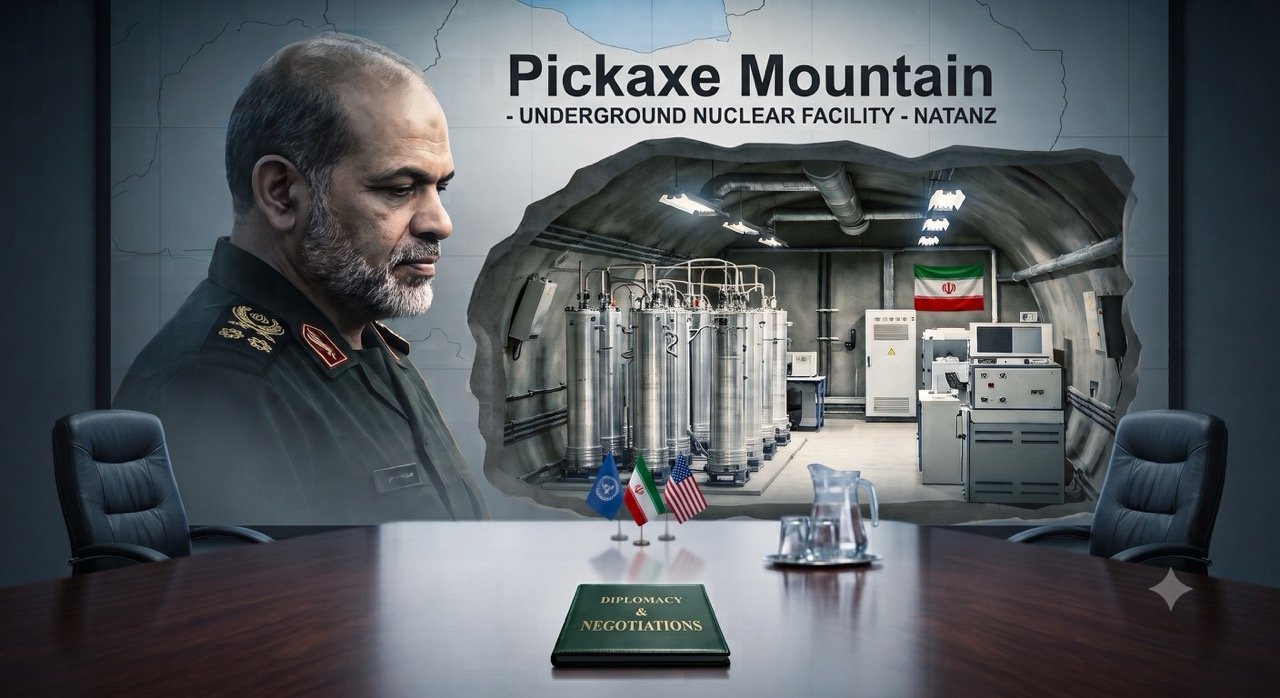
The folly of this diplomatic optimism is underscored by recent intelligence regarding "Pickaxe Mountain," a subterranean nuclear facility buried beneath nearly 100 meters of granite near Natanz. Reports that Iran is transferring centrifuges into this highly fortified bunker confirm that Tehran has zero intention of abandoning its nuclear ambitions.
Instead of pursuing flawed diplomacy, a more effective alternative is a relentless, sustained economic naval blockade. The Iranian economy, plagued by hyperinflation and a collapsing currency, is structurally fragile; a tight naval blockade could, potentially, destabilize the regime within months without even necessitating a return to full-scale war.
Throughout this U.S.–Iran friction, Israel has strategically maintained its distance. The fight for the future of the Strait of Hormuz is not an Israeli one.
Jerusalem has signaled that if dragged into the conflict, it will abandon proportionality and target the regime’s most sensitive, destabilizing assets.
Lebanon’s "Pilot Zone" Mirage
Meanwhile, shifting to the northern front, a critical test of sovereignty is unfolding in Lebanon. In an attempt to implement a diplomatic solution, the Lebanese Armed Forces (LAF) are deploying into two pilot zones near the re-established 10-kilometer deep Israeli security zone in southern Lebanon. The objective is to prove the LAF can dismantle Hezbollah’s military infrastructure, which is deeply embedded in civilian homes, schools, and hospitals, and prevent the terror group's return.
However, extreme skepticism is warranted. The LAF is heavily infiltrated by Hezbollah sympathizers, and its Shiite officers often hail from the very villages they are supposed to police. When a similar arrangement was attempted during the 2024 ceasefire, the LAF simply declared areas "demilitarized" while Hezbollah prepared to launch thousands of rockets southward.
The new performance-based pilot program will likely expose the LAF’s lack of capability and will. If and when it fails, it will provide undeniable international proof that the IDF must maintain its security buffer in southern Lebanon for the long haul to prevent future massacres in Israel's Galilee region.
Gaza: The Forgotten, Yet Active, Front
Meanwhile, the Gaza Strip has paradoxically become the 'forgotten arena,' overshadowed by the Iranian and Lebanese fronts. Yet, it remains a highly active theater. The IDF now controls approximately 60 percent of the territory, paving roads, building protective earth mounds, and establishing long-term posts.
Most notably, Israeli intelligence has achieved a dramatic operational recovery. On a daily basis, the IDF is systematically eliminating Hamas and Palestinian Islamic Jihad (PIJ) commanders, intelligence chiefs, and operatives who took part in the October 7 massacres and who remain actively engaged in terrorism today. While there is diplomatic discussion of an international stabilization force, potentially involving nations like Morocco, or transferring administrative control to heavily vetted local forces, the reality on the ground dictates that the IDF is in Gaza for the long term.
The Burden of the Long War
The overarching constraint tying these arenas together is personnel. Israel’s reservists are bearing an unprecedented burden, serving hundreds of days to sustain operations across Gaza, Lebanon, Judea and Samaria, and beyond. Prioritizing these fronts is a logistical necessity, which is one of the reasons why Gaza operations are currently paced behind the Iranian and Lebanese arenas.
Nevertheless, the compass of Israel's new security doctrine remains fixed across a 360-degree radius: no jihadist army will ever again be allowed to build capabilities on Israel's borders. It is a compass that will, sooner or later, lead back to Gaza, where the war first began.
Photo Credit: Photo Credit: The MirYam Institute-AI Generated ® All Rights Reserved
Yaakov Lappin is an In-House Analyst at The MirYam Institute and an Israel-based military affairs correspondent and analyst. Read full bio here.