

By Yaakov Lappin
As of mid-August 2026, Israel finds itself navigating a perilous diplomatic minefield across two distinct but interconnected arenas: Gaza and Lebanon.
In both theaters, a stark disconnect has emerged between the military realities on the ground and the illusionary diplomatic frameworks being aggressively pushed by international actors. Jihadist adversaries are utilizing this diplomatic theater for a single, calculated purpose: buying time to survive, and recuperate.
The diplomatic dissonance is most glaring in Gaza, where recent maneuvers by Washington represent a deeply problematic approach to Hamas. President Trump’s special envoy, Jared Kushner, recently held on in Cairo (on August 16) talks with senior Hamas figures, including Khalil al-Khaya, the head of the terror organization's political bureau. Treating the architects of the October 7 massacres as legitimate negotiating partners and expecting them to respond to negotiations in the same manner that moderate, rational, forward-looking Gulf states did during the Abraham Accord negotiations defies any strategic logic.
It is tantamount to dispatching a U.S. delegation to bargain with ISIS. Media leaks from subsequent tense meetings (on August 17) in Jerusalem indicate that Prime Minister Benjamin Netanyahu was deeply dissatisfied with Kushner's direct meetings with Hamas in Cairo.
Meanwhile, the internationally backed Board of Peace and the proposed International Stabilization Force, slated to be commanded by former U.S. Special Operations in Central Command chief Gen. Jesper Jeffers, were stopped by Israel from advancing to further fantasy.
Hamas had in recent weeks ostensibly agreed to transfer its arsenal into "storage" under a future Palestinian technocratic government.
Anyone familiar with the 2007 Gaza Hamas coup knows exactly how this playbook ends. Hamas would simply rule from the shadows, easily overpowering any newly trained administrative police force and reclaiming its weapons the moment the opportunity would arise. As a result, Israel is insisting that any disarmament process involves the destruction of weapons collected, not their storage – a clause Hamas will never accept.
The Missing Israeli Agenda
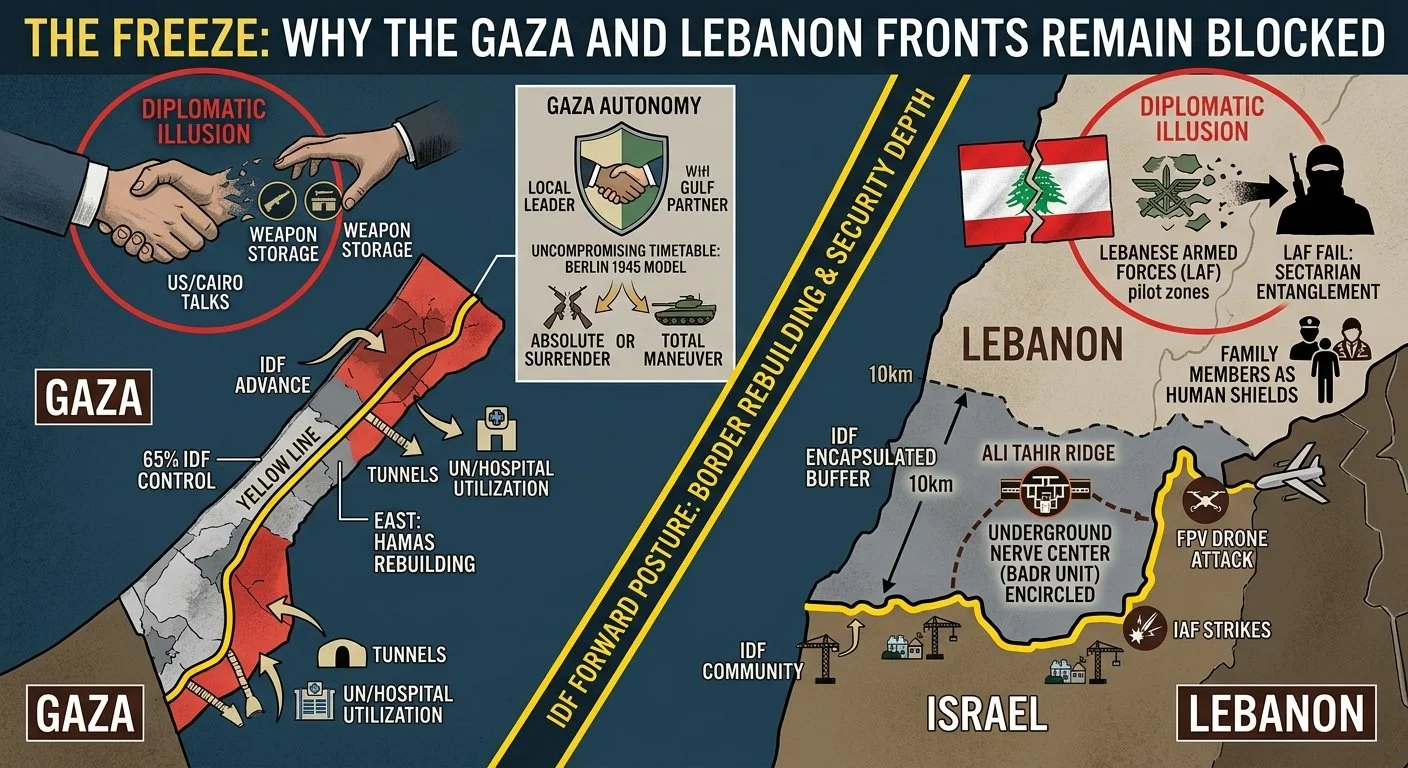
West of the operational "yellow line" in Gaza, the IDF maintains control over roughly 65% percent of the Gaza Strip, continually unearthing complex tunnel infrastructure. East of that line, Hamas continues to terrorize its own civilians, utilizing UN facilities, hospitals, and mosques not only to rebuild military capabilities but to torture political dissidents and execute civilians in the streets, according to IDF data. The IDF's control over large swaths of Gaza provides, however, the needed security depth to allow southern Israeli communities to once again flourish.
The primary vulnerability in Israel’s current posture is the absence of its own proactive diplomatic agenda, which has created a vacuum for others to fill with deeply flawed arrangements. Israel must present a clear, uncompromising timetable for Gaza, modeled on Berlin in 1945.
There can only be two options on the table:
Absolute Surrender of Capabilities: The total destruction, not storage, of every weapon, from anti-tank missiles to AK-47s, alongside full mapping and dismantlement of all subterranean infrastructure.
Total Maneuver: If Hamas refuses, the IDF must be unleashed to finish systematically taking the rest of the Gaza Strip and destroy Hamas's capabilities.
Only after complete demilitarization can a realistic conversation begin regarding a localized Gaza autonomy, ideally supported by Gulf partners like the UAE, focusing on comprehensive educational deradicalization.
Lebanon’s Failing Sovereignty Test
A similar diplomatic mirage is unfolding in the north. The current international strategy relies on two "pilot zones" where the Lebanese Armed Forces (LAF) are tasked with demonstrating their ability to disarm Hezbollah. Unsurprisingly, the LAF is so far failing the test entirely.
Sectarian realities—where nearly half of the LAF is Shi'ite and deeply entangled with Hezbollah’s social and military fabric, render them systemically incapable of confronting the terror group. There is zero evidence of the LAF systematically dismantling bunkers or confronting Hezbollah operatives.
Consequently, the IDF remains firmly entrenched 10 kilometers deep into southern Lebanon, preempting immediate threats. A prime example is the ongoing encirclement of the Ali Tahir Ridge in the Nabatieh area, a massive subterranean nerve center commanded by Hezbollah’s Badr territorial unit. When Hezbollah terrorists attempted to relieve pressure on their trapped operatives using an FPV drone, injuring two soldiers and an officer from the IDF's elite Yahalom combat engineering unit, the Israeli Air Force responded with force. Targeted strikes eliminated senior Badr and Radwan commanders, neutralizing operatives, some of whom, in a display of cynical cruelty, were reportedly utilizing their own family members as human shields.
The Imperative of the Forward Buffer
The overarching lesson from both Gaza and Lebanon after October 7 is that Israel has no margin for error. International forces and compromised state armies cannot be trusted to secure Israel's borders because they lack the ability to do so until proven otherwise, and the Israeli security establishment intimately understands that the IDF must maintain its forward presence across these perimeters for the long haul. Even absorbing a smaller scale terror attack jeopardizes Israel's fragile border communities.
It is solely because of Israel's military buffers that communities in Israel's north and south are finally beginning to rebuild, feeling secure enough to look toward the future. Grand diplomatic arrangements may dominate the headlines in Washington and European capitals, but survival in the Middle East is dictated by actual capability and the steadfast determination to utilize it, not lofty promises that are not backed up by reality.
Photo Credit: Photo Credit: The MirYam Institute-AI Generated ® All Rights Reserved
Yaakov Lappin is an In-House Analyst at The MirYam Institute and an Israel-based military affairs correspondent and analyst. Read full bio here.