

By Yaakov Lappin
IDF establishes four-tier defense in southern Lebanon as ground maneuver dismantles Hezbollah strongholds
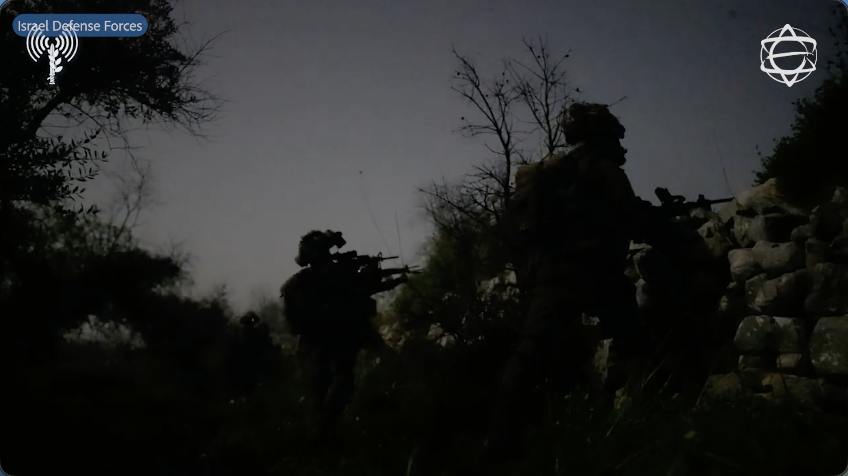
The Israel Defense Forces has officially classified Lebanon as the primary war arena, as it implements a major ground maneuver with five divisions to systematically dismantle Hezbollah's military infrastructure and establish a long-term four-tier defense buffer zone to protect northern communities.
The strategic shift allows the Israeli Air Force to concentrate its operations over Lebanese territory while observing the U.S.-led ceasefire with Iran. Lebanon is defined as the main operational front at this stage.
The military marks these achievements on April 13, the eve of Yom HaShoah, the national Holocaust Remembrance Day. Eighty-one years since the end of World War II, in the midst of a multi-front conflict with genocidal jihadist enemies, we take a day to remember the industrial genocide of six million Jews. The modern State of Israel confronts adversaries possessing similar intents, utilizing the instruments of a sovereign nation-state and a powerful military to successfully protect the population this time.
In southern Lebanon, the IDF is currently surrounding and securing Bint Jbeil, a city that previously served as a central symbol and operational hub for Hezbollah. The military expects to establish full operational control of the city within days, with only a small number of terrorists remaining.
Hezbollah had prepared the city as a primary launchpad for cross-border raids into northern Israel by its death squads. Now, the raid threat along with the anti-tank missile fire, has been removed.
Inside Bint Jbeil, Hezbollah systematically utilized a Lebanese government hospital as a fortified military base. IDF soldiers identified several terrorists conducting surveillance and firing on troops from the hospital windows. Following the initial engagement, the military neutralized the terrorists as they tried to exit the hospital.
Ground forces searching the facility subsequently located a cache of weapons stored inside.
To permanently secure the northern communities, the military is constructing four distinct lines of defense.
The first line rests directly on the border, involving significant engineering operations to destroy structures used by Hezbollah to prepare invasion launchpads. This line has seen the IDF expand its number of positions from 5 to 15.
The second line involves defensive strongpoints within Lebanon. The third layer neutralizes direct-fire anti-tank missile threats to northern communities. The final boundary is the Litani River. The IDF will control the entire zone to prevent the infiltration of additional terrorists and will not allow hundreds of thousands of southern Lebanese residents, primarily Shi'ites used by Hezbollah to build a shadow, Iranian-backed state, to return until the security of northern Israel can be assured.
The campaign inflicted severe damage on Hezbollah's fighting force, including the IDF's Operation Eternal Darkness, which was an extraordinarily strong blow that saw dozens of fighter jets strike some 100 targets throughout Lebanon in the space of ten minutes.
Over 250 terrorists were eliminated in that strike, bringing the number of estimated Hezbollah casualties since March 2 to over 1,500, more than double the number of casualties Hezbollah sustained in the 2006 Second Lebanon War. This includes hundreds of terrorists from the elite Radwan terror unit, whose job was to spearhead the planned Hezbollah invasion of the Galilee – a plan Hamas ended up copying and applying to southern Israel on October 7, 2023.
Hezbollah continues to launch large volumes of fire at Israel. Since entering the war on March 2, the terror group has fired over 6,500 projectiles, including rockets and unmanned aerial vehicles. Half of these projectiles originated from south of the Litani River, an area where the Lebanese government and UNIFIL previously falsely claimed Hezbollah had been disarmed. The remaining half was launched from north of the Litani. UNIFIL forces, responsible for enforcing UN Security Council Resolution 1701, engaged in complete theatrics, allowing Hezbollah to operate freely. The IDF has responded by striking more than 4,300 terror infrastructure targets across Lebanon and dismantling 200 rocket launchers.
The military offensive systematically dismantles the shadow state Hezbollah built to sustain its forces.
Iranian-backed terror armies require civilian and social ecosystems to recruit from and to embed their offensive capabilities under civilian disguises. Hezbollah exploits international media to legitimize its operations through information warfare, utilizing journalists who fail to report on the IDF's unprecedented efforts, including calls and text messages, to limit harm to noncombatants, or to shed light adequately on Hezbollah's cynical human shielding modus operandi.
The intense military pressure is generating rapid strategic effects.
The ground operation has triggered a massive demographic shift in southern Lebanon, with over 600,000 Shiite residents evacuating the area following military warnings. The terror group is now forced to alter its deployment patterns, including a withdrawal from its stronghold of Dahieh in southern Beirut, spreading into northern Beirut and into mixed neighborhoods, expanding the risk to other sects within Lebanon.
Concurrently, the Lebanese government has publicly acknowledged that Hezbollah and Iran are the cause of the war and expressed a desire to negotiate directly with Israel. This development damages Hezbollah's legitimacy as the self-proclaimed "defender of Lebanon," positioning the group instead as an Iranian occupying force.
Photo Credit: Israel Defense Forces
Yaakov Lappin is an In-House Analyst at The MirYam Institute and an Israel-based military affairs correspondent and analyst. Read full bio here.