

By Yaakov Lappin
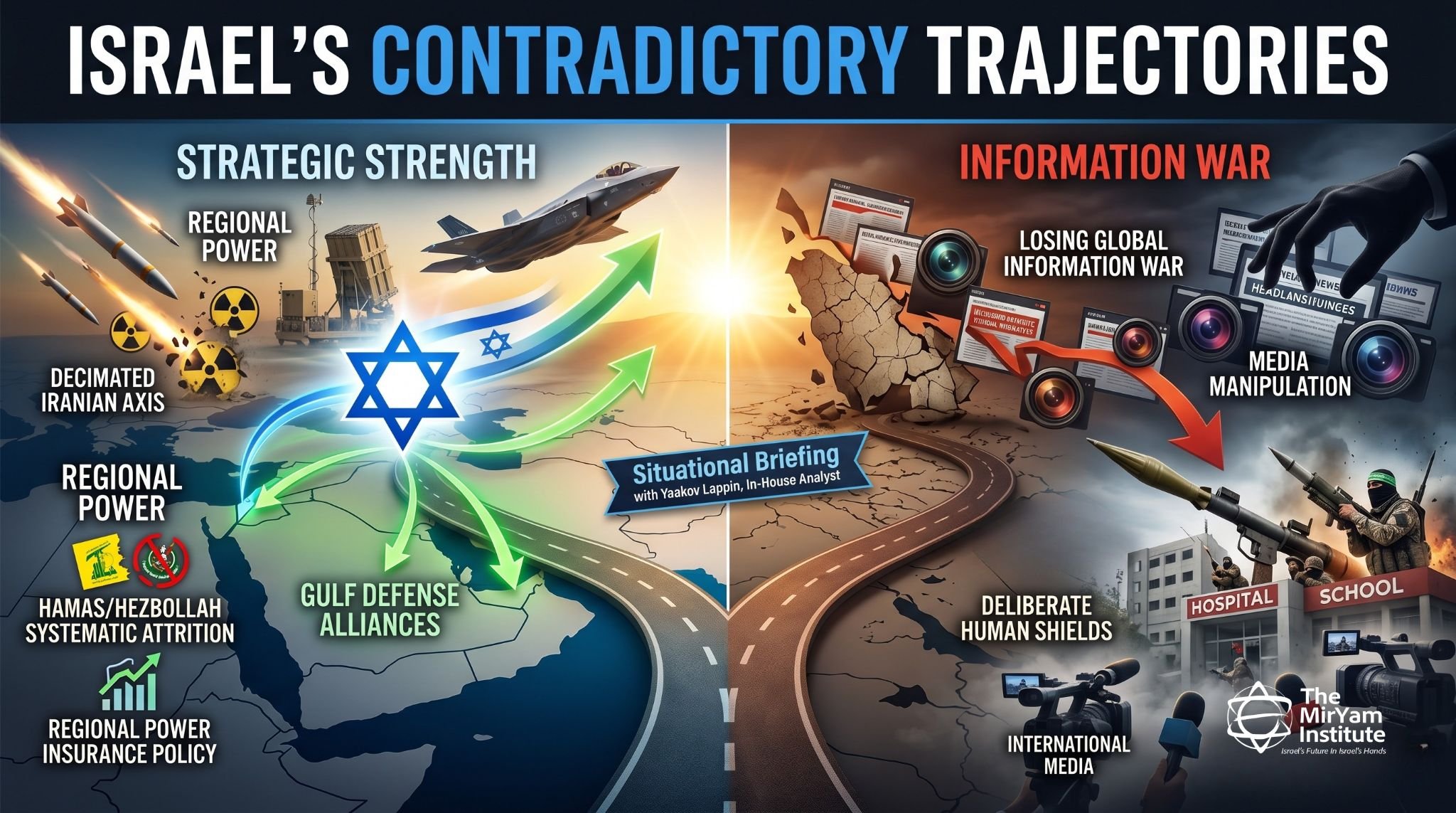
Since October 7, 2023, Israel has experienced two diametrically opposed trajectories regarding its national security and global positioning. On the physical battlefield, and in its strategic regional situation, Israel is seeing a continual and gradual improvement across every front and against every active threat.
Conversely, there is an inverse deterioration in Israel’s international standing, a phenomenon that is not coincidental but rather entirely by design.
Both trajectories result from the same reasons.
Israel’s adversaries in Gaza and Lebanon, acting under Iranian guidance, have systematically entrenched their military infrastructure within civilian areas, such as hospitals, schools, clinics, and villages.
Simultaneously, they and their backers in Tehran and Qatar spent years building an infrastructure to exploit the international media, social media algorithms, and the higher education ecosystem that are under heavy influence by Islamist pro-Hamas networks in the West.
On the battlefield, the attempts by Iran, Hamas, and Hezbollah to gain tactical advantages over the IDF by human shielding have failed. Israel has learned how to detect and neutralize these threats successfully. In the information battlespace, however, these enemies have successfully waged an information, propaganda, and psychological war, scoring points on the legitimacy battlefield even as they grow physically weaker, by selling the world a fraudulent narrative that frames the conflict as if Israel were attacking civilian areas.
The core of this multi-front threat is the Iranian regime, often described as "head of the snake" due to its lead roll in an axis of jihadist forces.
Without Iranian funding, weapons, training, and military doctrine, proxy groups like Hamas and Hezbollah would never have morphed into the monstrous threats they became prior to the start of the war, threats Israel failed to preemptively neutralize.
Today, however, every parameter indicates that the Iranian regime is significantly weaker. Despite claims to the contrary, Iran’s nuclear program has been severely degraded. All of Iran's uranium enrichment facilities were destroyed in the June 2025 war, and were never rebuilt, meaning Tehran currently lacks the capacity to enrich uranium.
While assessments indicate that Iran still possesses 440 kg of highly enriched uranium buried in two sites (Isfahan and Fordow), the regime has no access to it; these locations are under 24/7 surveillance, and any attempt to approach the material would likely result in an immediate bombing . Consequently, the nuclear program has been set back by years, not merely months.
Furthermore, Iran's ballistic missile program has suffered a massive blow, with 60% of its launchers—the critical bottleneck for firing missiles—taken out of commission, according to IDF assessments. No less importantly, the regime's broader weapons industry has also been hit hard, with almost all Iranian weapons industry sites smashed by airstrikes. Contrary to popular misconceptions, replacing destroyed bases and decades' worth of missile construction infrastructure, which cost tens of billions of dollars to build, cannot be done overnight.
The Iranian leadership has been decimated from Ayatollah Khamenei downward, including intelligence heads and the IRGC commander, who is now the third replacement after his two predecessors were eliminated.
Because these commanders possess unique, decade-long experiences and connections, they are highly difficult to replace.
Economically, Iran is facing systematic breakdown and dysfunction. The country has lost 40% of its pre-war GDP, according to estimates by the Foundation for Defense of Democracies, compounding an already dysfunctional economy that sparked mass protests in January, during which the regime killed at least 30,000 of its own citizens.
Currently, an effective blockade enforced by U.S. CENTCOM has choked off Iran's oil exports to China, which previously accounted for 90% of its energy purchases, causing the regime to lose an estimated $400 to $500 million every single day.
Despite the regime’s propaganda designed to project strength and prevent internal destabilization, it has not been this weak in many years, raising long-term doubts about its survival once it can no longer pay salaries to its repressive internal Basij state militia.
Hezbollah – a shadow of its former self
Iran’s primary proxies have suffered similar strategic disasters. Before October 7, Hezbollah boasted one of the largest firepower arsenals in the world, surpassing most NATO armies with over 200,000 warheads of various kinds. Today, that number has been reduced to just under 20,000 rockets and a few thousand mortars, forcing the group to rely heavily on guerrilla warfare, such as the use of fiber-optic FPV drones copied from the Russia-Ukraine battlefield. While certainly still a major threat to the IDF operating in the new Israeli security zone, Israel's northern civilian communities are far safer already.
Crucially, Hezbollah has lost control of its heartland in southern Lebanon. The IDF has established an 8 to 10-kilometer security zone, effectively taking the threat of a massive, October 7-style cross-border invasion off the table and forcing the evacuation of Hezbollah’s Shiite human shields.
In addition to losing over 80% of its firepower, Hezbollah has lost roughly 2,000 operatives in the past month alone, alongside its historic leadership. The new leader, Naim Qassem, lacks the charisma and regional influence of Hassan Nasrallah.
Politically, Lebanese officials are now openly blaming Hezbollah and Iran for dragging the country into war, signifying a massive loss of internal legitimacy. Furthermore, Hezbollah's traditional weapons smuggling land bridge through Syria has been severed by the new Sunni Al Shara regime, which views Hezbollah as an enemy and actively intercepts Iranian arms shipments.
Although President Trump has requested Israel limit its strikes on Hezbollah threats to southern Lebanon to facilitate talks with Iran, Israel must eventually strike Hezbollah in Beirut and the Beqaa Valley once again. Those who propose to create a sovereign Lebanese state must support such strikes, since the equation is crystal clear – a weaker Hezbollah is an essential prerequisite for a truly sovereign Lebanese state that could actually police its own territory and enforce UN Security Council resolutions banning the presence of non-state terror armies.
Hamas – a significantly weaker strain
Similarly, Hamas has been reduced to a fraction of its former strength. While it still controls roughly 50% of the Gaza Strip and maintains about 20,000 armed terror operatives, and is attempting to manufacture rudimentary weapons, it is entirely hemmed in by the IDF.
By losing control of the Rafah and Philadelphi corridors on the Egyptian border, Hamas has lost its primary overground and underground smuggling lifelines. The IDF conducts daily operations to clear terror infrastructure and neutralize Hamas cells attempting to cross the "yellow line" into Israeli-controlled areas.
Although ceasefire negotiations discuss Hamas disarming, the group's jihadist DNA ensures it will never genuinely surrender its weapons, meaning an Israeli operation to complete the war's goals in Gaza is all but inevitable.
As Iran and its proxy system weaken month by month, their narrative strengthens worldwide, and all for the same reasons.
The disconnect between Israel's military successes and its global image is a direct result of the enemy's media strategy.
By operating from within civilian homes and subsequently editing out combatants from the imagery of destroyed buildings, terrorist groups manipulate the international media into advancing a false narrative.
Media outlets that comply with this propaganda factory are, intentionally or not, boosting a jihadist cause that poses a direct threat to the security and future of the entire Western world.
Photo Credit: The MirYam Institute-AI Generated-® All Rights Reserved
Yaakov Lappin is an In-House Analyst at The MirYam Institute and an Israel-based military affairs correspondent and analyst. Read full bio here.