

By Yaakov Lappin
In the wake of a deeply flawed U.S. - Iran 60-day agreement signed in June, which quickly dissolved into a low-grade naval war of attrition in the Strait of Hormuz, Israel is not gambling its core security interests on flawed diplomatic processes, particularly ones it had no role in negotiating.
While Washington and Tehran engage in direct military friction, Israel has managed to remain on the sidelines of this specific clash, focusing instead on its borders, but monitoring events in Iran closely, with the Israel Defense Forces preparing for a range of scenarios.
The current naval escalation in the Persian Gulf stems from what is best described as a "memorandum of misunderstanding." Signed in June 2026, the Islamabad Memorandum of Understanding (MOU) was intended to create a temporary 60-day diplomatic window to resolve U.S.–Iran nuclear disputes. Instead, it guaranteed a collision course due to diametrically opposed interpretations of maritime access in the Strait of Hormuz and maritime energy traffic.
While Washington believed the MOU secured safe passage for commercial shipping along the Omani coast, Tehran assumed it recognized Iranian sovereignty over the Strait of Hormuz. Desperate to salvage an economy devastated by war and mismanagement by the Islamic Republic, Tehran began firing on passing tankers heading down the 'wrong' sea lanes outside of its control.
This prompted a swift response from U.S. Central Command (CENTCOM), which initiated nightly airstrikes against Iranian radar stations, drone bases, and anti-ship missile sites. Despite the intensity of these strikes, which featured the first operational deployment of autonomous U.S. suicide naval vessels, the conflict has not spilled over into Israel. Israeli decision-makers are warning Tehran that any attempt to draw Israel into the fray would trigger devastating retaliation against the regime's most vulnerable domestic targets.
Throughout these events, Israel is acting upon its post-October 7 security paradigm. The old reliance on passive containment, defense-at-the-border, and the illusion of "deterring" jihadist actors has been discarded. Under this updated doctrine, Israel acts preventatively whenever intelligence reveals the accumulation of threatening capabilities. This active stance was demonstrated during the June 2025 campaign against Iran's nuclear sites, and again on February 28, 2026, when Israel and the U.S. launched Operation Roaring Lion, severely degrading Iran's long-range missile program.
The Lebanese test case
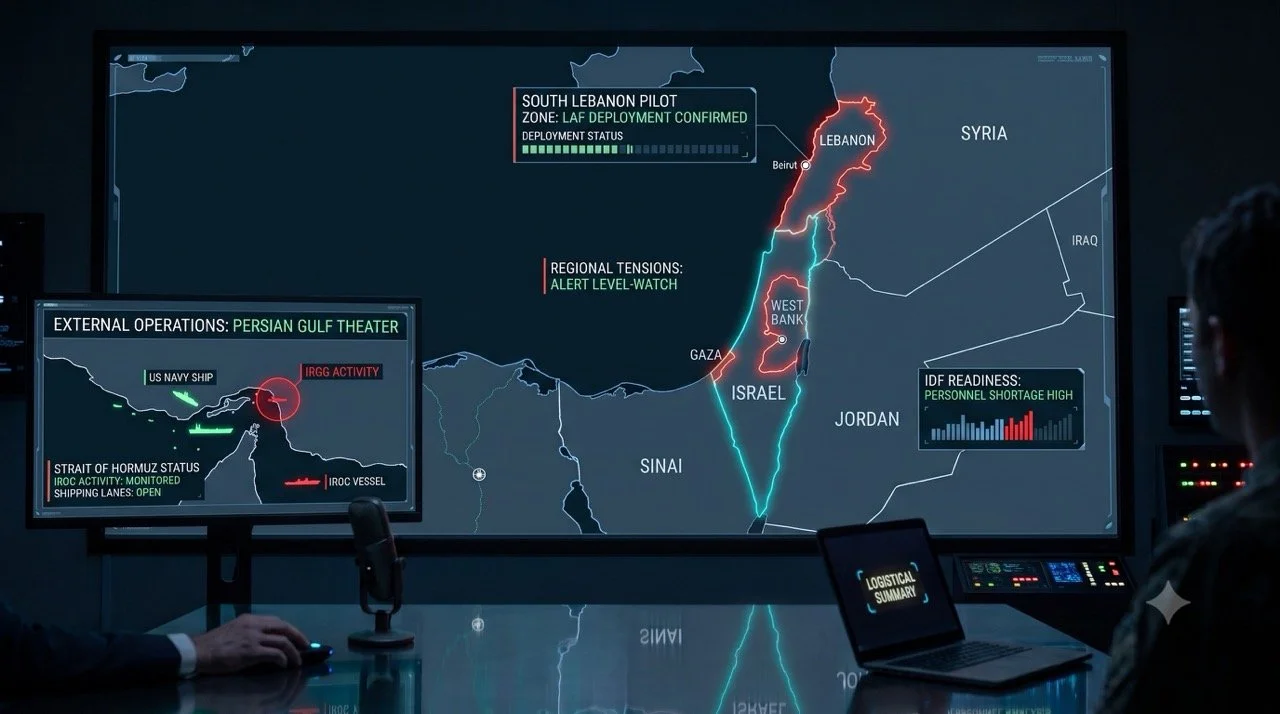
A critical test of this doctrine is currently unfolding in southern Lebanon, where the IDF maintains a 10-kilometer-deep security zone designed to prevent Hezbollah from rebuilding its offensive border infrastructure. To explore diplomatic alternatives, American-brokered talks in Rome are establishing two localized "pilot zones." In these areas, the Lebanese Armed Forces (LAF) are tasked with dismantling residual terrorist infrastructure and keeping Hezbollah out. Although Israeli planners remain highly skeptical of the LAF's capability to confront Hezbollah, the process holds diplomatic value. By participating, Beirut has formally acknowledged Israel's right to maintain its security presence in the south until a competent, sovereign Lebanese force can demonstrably secure the area. This isolates Iran and its terror proxy, Hezbollah, while also preventing a rapid withdrawal of the IDF.
Yet, maintaining these active buffers, spanning not just southern Lebanon, but also over 60 percent of the Gaza Strip, southern Syria, and routine operations in Judea and Samaria, presents a massive logistical and human challenge. The concept of a "small, smart high-tech army" has proven entirely inadequate for sustained territorial defense.
This reality has brought Israel’s internal societal divisions to a head, highlighted by a formal letter from IDF Chief of Staff Eyal Zamir to the Knesset demanding the end of the exemption of the ultra-Orthodox (Haredi) sector from the draft, or the government's move to avoid criminal sanctions on draft dodging.
With secular, traditional, and national-religious reservists serving hundreds of days under extreme strain, the exemption of an entire sector of society has become mathematically untenable. The IDF has sought to address this constructively by establishing dedicated Haredi frameworks, such as the newly active Hasmonean Brigade (Hakashmonaim), which preserves religious lifestyles while producing effective combat units. But this needs to be scaled up, and quickly.
For Israel's new security doctrine to succeed, sufficient personnel — reservists, conscripts, and career soldiers — must be available to operate in the security zones all around the country's borders. It's not a matter of right or left, but of national security.
Photo Credit: Photo Credit: The MirYam Institute-AI Generated-® All Rights Reserved
Yaakov Lappin is an In-House Analyst at The MirYam Institute and an Israel-based military affairs correspondent and analyst. Read full bio here.